

A Closed Album, a Porch Table, and the Photos That Arrive on Their Own
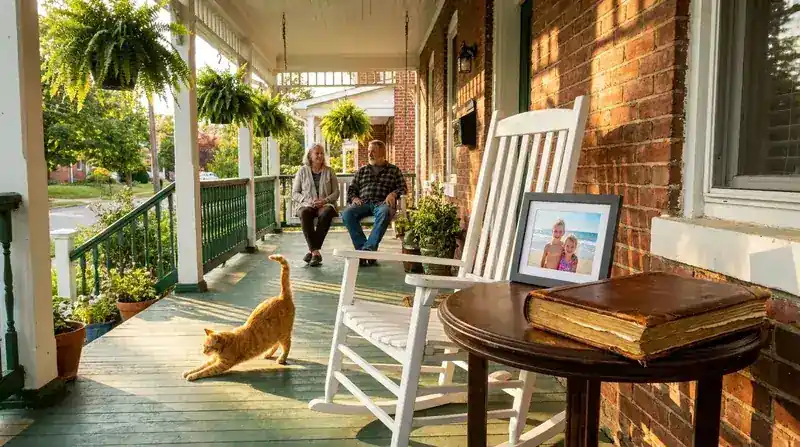 Porch Table · Frame No. 1
A retired wedding photographer puts a small frame on his porch table, and his daughter's photos start arriving with a line of caption underneath. The price, the setup and the return rules, read honestly.

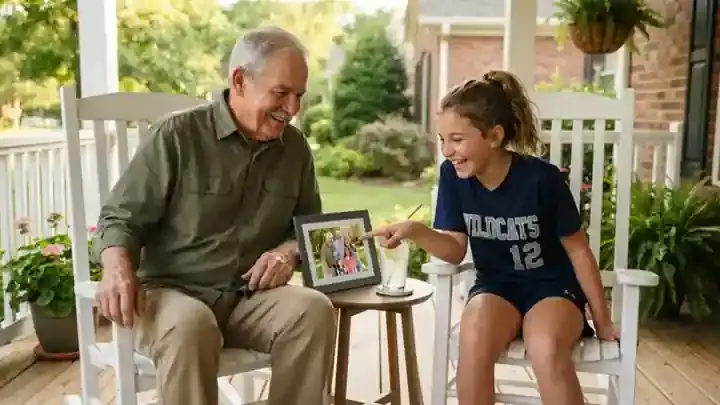
On a Tuesday in late September, at ten minutes past four, a picture arrived on my porch table while I was looking at the street. I didn't touch anything, and nobody knocked.
It was my granddaughter Lily, eleven years old, standing next to a science fair poster about bean plants. Under it, in small white letters, my daughter had typed one line:
"Lily, third place, Raleigh, Thursday, she says tell Grandpa the light was terrible."
I laughed out loud on an empty porch. The cat looked at me like I'd lost my senses.
The light was terrible, by the way. Fluorescent tubes in a school gym, flat and green, the kind of light I spent forty years fighting at wedding receptions in fire halls.
But I could see her face.
I could see it from my rocking chair, at the size of a hardcover book, without hunting for my reading glasses or asking anybody which button to push.
This is a column about that small frame on my porch table.
It's also about the thirty-one albums in my hall closet, a neighbor two houses down, and a name I couldn't find at the hardware store.
I'm going to tell you what the frame does and what it doesn't.
I'm also going to tell you plainly that it did nothing for my head, because it was never built to, and I won't let anybody tell you otherwise.
What it changed was what's sitting on the table next to my chair.
For a man who spent his working life deciding what goes in a frame, that turned out to matter more than I expected.
Forty Years of Other Families' Best Days
I opened Calloway Studio on Potomac Street in Hagerstown, Maryland, in the spring of 1978.
I was twenty-two, I had one borrowed medium-format camera, and I had no idea how to talk to a bride's mother.
I closed it in 2018 after 1,140 weddings. I know the number because Marian kept the ledger, and Marian doesn't round.
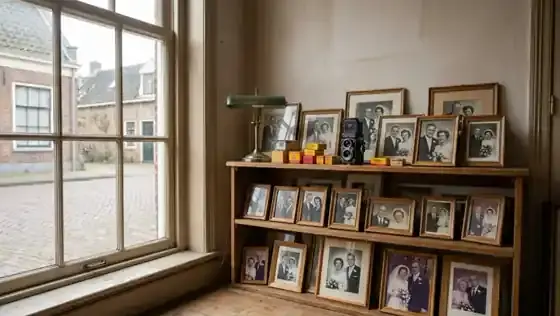
A wedding photographer's whole job is one day that belongs to somebody else.
You arrive before the bride is dressed and you leave after the cake is cut, and in between you try to be invisible and everywhere.
I photographed fire-hall receptions, country-club receptions and one reception in a dairy barn where a heifer walked through the toast.
I photographed three generations of the same family, the grandmother in 1981 and her granddaughter in 2016.
The part people don't know is what comes after.
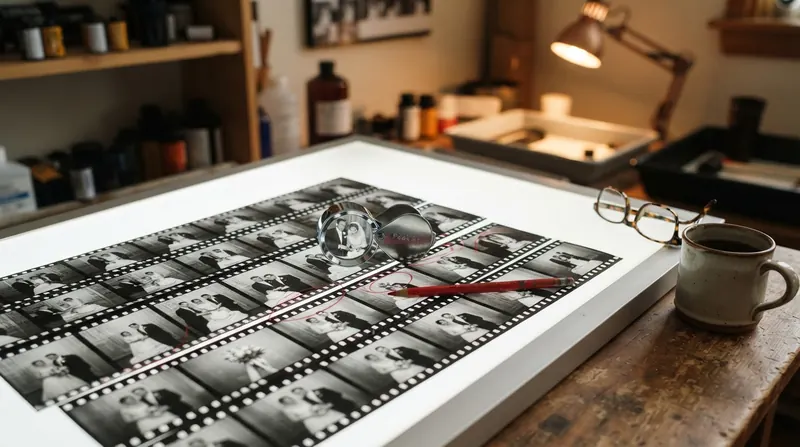
For every wedding, I sat at a light table with a loupe and a grease pencil and chose about two hundred frames out of eight hundred.
Then I laid them into an album, page by page, in an order that told the day like a story.
Getting ready, the church, the vows, the receiving line, the toast, the first dance, the car pulling away.
And under the photos I cared about most, I wrote a line. Not much, just a cutline the way a newspaper does it: who, where, what they were laughing at.
"Aunt Dolores, front pew, 11:52 a.m., already crying"; "Best man, Fountainhead Country Club, the toast that went on too long."
The picture holds the face; the line underneath holds the moment.
I learned that from an old newspaperman at the Herald-Mail who bought a few of my photos in my first year.
He told me a photo without a caption is a stranger, and a photo with a caption is a neighbor.
I believed him for forty years at other people's weddings. I just forgot to believe him in my own house.
Thirty-One Albums and the Year They Stopped
In the hall closet of our house on Oak Hill Avenue there are thirty-one family albums.
They're the good kind with the heavy pages, and I made every one of them on the same light table I used for work.
The first one is our own wedding in 1979, at Saint John's, with my friend Gary shooting because the groom can't. The last one is Christmas 2009.
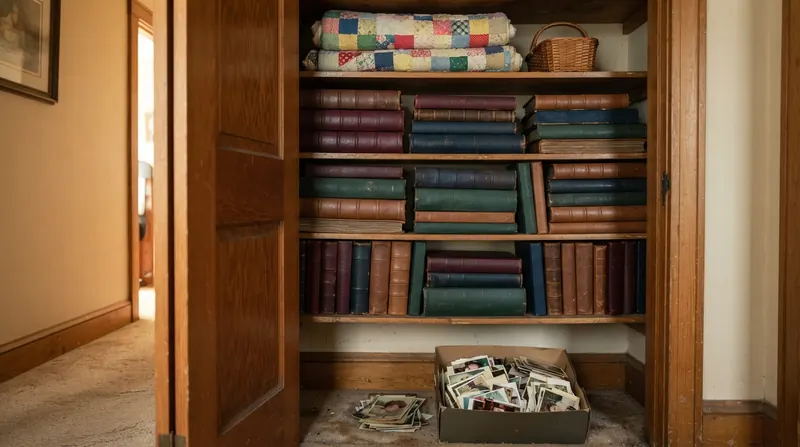
I've asked myself why it stopped in 2009, and the honest answer is the telephone.
That was the Christmas Allison showed up with her first phone that took decent pictures, and by the next summer nobody in my family printed anything.
The pictures didn't stop, of course. There were more of them than ever, thousands more.
They just stopped arriving at my house.
They lived on other people's phones, in other people's pockets, and I saw them when somebody remembered to hold a screen in front of my face.
Marian handled it better than I did.
She has a tablet and she knows how to make the photos bigger with two fingers, and she'd sit at the kitchen table on Sunday nights scrolling through what Allison had posted that week.
I'd lean over her shoulder for a minute and then go back to the porch. I'll be honest with you: I resented the glass.
Forty years of choosing the frame, and now every picture of my own grandchildren came at the size of a playing card, behind a reflection, in a color nobody had corrected.
A professional complaint, maybe, but a real one.
So the albums stayed closed.
The last time I'd opened one before this year, I had to move a vacuum cleaner and two winter coats to get to it, and I gave up halfway.
A Name on the Tip of My Tongue at the Hardware Store
The moment I want to tell you about happened at Hoffman's Hardware in March. I was buying a box of deck screws for a loose board on the porch steps.
The young man at the register, a nice kid with a neck tattoo of a fishing lure, said, "Your neighbor was in here yesterday, the one across the street from you.
Said to say hello."
And I said, "Oh, good, tell him hello back." Then I stood there trying to say the man's name out loud, and it would not come.
Gene Hollis has lived across Oak Hill Avenue from me for thirty-one years.
He helped me carry a sleeper sofa up our stairs in 1996 and I photographed his daughter's wedding in 2004 at no charge, which I've never mentioned to him and won't.
The name was right there, the way a word sits on the tip of your tongue in a crossword.
I could see his green Buick and his wife's tomato plants and the way he waves with two fingers off the steering wheel.
"Gene," I said, finally, out in the parking lot, to nobody. It came back in the truck, about a mile down Potomac Street, at the light by the courthouse.
Now, I'm seventy. Every man I know my age has a story like this, and most of them tell it as a joke at the barbershop, and so do I.
I'm not telling you about Gene because it scared me. I'm telling you because of what happened that same week, which felt like it came from the same drawer.
That Sunday, on the phone with Allison, I asked how Sam's soccer was going. There was a pause, and then she said, kindly, "Dad, Sam quit soccer last fall, he swims now."
Sam is seven.
A year is a long time when you're seven, and I'd missed it completely, not because anything was wrong with me but because I'd never seen a single picture of that boy in a pool.
I wrote that card the way I used to write cutlines. Then I looked at it and understood something an old newspaperman told me in 1978:
a fact with no picture next to it slides right off the table.
I'd had pictures next to facts for forty years at work. At home, all the new pictures were in somebody else's pocket.
Arlene's Porch Table
Arlene Pruett lives two houses down from us, in the yellow house with the ferns.
She's seventy-six, a widow, and she was the secretary at Saint Mark's for twenty-nine years, which means she knows every family in this part of town by birthday.
In April I walked down to bring back a casserole dish of hers that had been in our kitchen since Easter.
She waved me up onto her porch and said, "Sit down, Ned, Darnell's about to send me something."
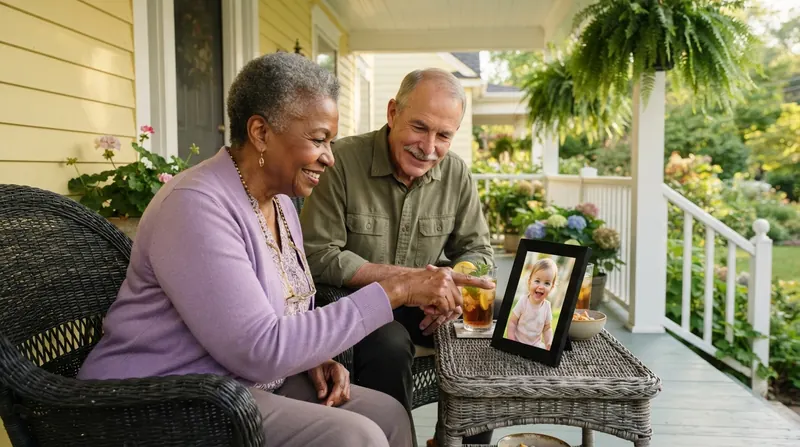
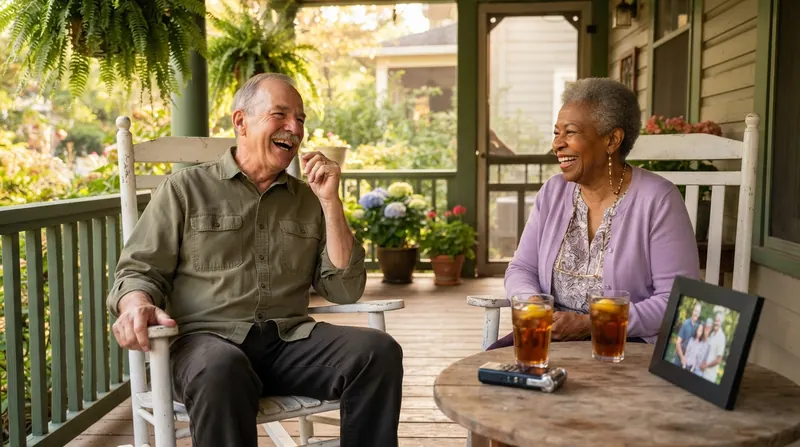
On the little table beside her chair there was a dark gray frame, about the size of a hardcover book, with a white border inside it.
A photo of a desert sunset was on it when I sat down.
"Watch," she said. And about two minutes later, without Arlene touching anything, the sunset slid away and a new picture came up.
It was her great-grandson in Phoenix, maybe two years old, in a barber's chair with a cape around his neck and an expression of total betrayal. Under the photo was one line:
"Josiah's first haircut, he forgave the barber by lunch."
I looked at that line for a long time. Darnell had written a cutline, and it was a good one, better than half the ones I wrote in the eighties.
"How does it get there?"
I asked, and Arlene took off her reading glasses so she could look at me properly, which is what she does when she's about to explain something twice.
"Darnell sends it from his phone, with an app," she said. "I don't do anything; the frame's on the Wi-Fi and the pictures just come."
"Can you send back?" I said, and she said, "No, "and I don't need to, I call him on the telephone like a civilized person."
Then she said the sentence that started all of this: "It's a little newspaper, Ned, and it only prints my family."
I sat on Arlene's porch for an hour and a half that afternoon. Four more pictures came in while I was there:
a Sunday dinner, a dog in a sweater, a church picnic and a blurry photo of a lizard that Darnell had captioned "Phoenix wildlife, very brave."
Every one of them had a line underneath. And every one of them Arlene had something to say about, a story behind it, a name.
When I walked home I didn't go inside.
I sat down in my rocking chair and looked at the empty spot on my side table where the newspaper usually sits, and I felt the way I used to feel at a light table when I'd found the frame.
Did you get home all right, or are you still sitting on my steps thinking?
7:58Home, thinking on my own steps now. What's the name of that frame?
8:03It says Relish on the box, and the app is called Frameo. Darnell did the setting up.
8:04Josiah's caption was better than mine in 1984.
8:06Don't tell Darnell. He'll start charging.
8:07I didn't order one that night.
I'm a careful man with a credit card, and I've been sold enough gear in my life to know the difference between a nice afternoon and a good purchase.
So I did what I used to do with every new lens.
I read the seller's own page from top to bottom before I'd let myself want it.
What Allison Said Before I Finished the Sentence
I called Allison the next evening to tell her about Arlene's porch.
I got about three sentences in, as far as "a frame where Darnell's pictures just show up," before she interrupted me.
"Dad," she said, "I have been trying to get you to let me do that for four years."
I had no memory of this, and Marian, from the kitchen, said, "She has, Ned."
It turns out that every Christmas since 2021, Allison had suggested a digital frame, and every Christmas I had said some version of the same thing.
I'd said I didn't want a screen in the living room, didn't want to learn another gadget and didn't want another bill.
Allison is forty-four and a project manager for a hospital construction firm in Raleigh. She does not argue with people, she schedules them.
"Here's the deal," she said. "You read the page, and if you still don't want it, I'll never bring it up again."
"And if I do?"
I asked, and she said, "Then I order it, it comes to your house, I set it up on the phone with Mom, and you never touch a menu."
Link sent. Read it like you used to read a lens review, slowly.
9:12Is there a monthly charge? Arlene says no but Arlene thinks the cable bill is a donation.
9:20No monthly charge on this one. It's on the page, in the questions at the bottom.
9:21It doesn't do video calls.
9:34Correct, you hate video calls. You hold the phone under your chin.
9:35Fair.
9:36She was right about the chin, and she was right that I'd read it like a lens review.
That's the next part of this column, and I'll go slow, because this is where most advertisements go fast.
The Seller's Page, Read Like a Lens Review
The frame is sold by a company called Relish.
Their legal name, from the terms on their website, is Active Healthcare Solutions Ltd, a company registered in England and Wales, with an office at 72 Leonard Street in London.
That surprised me, so I read further: the American part of their store says "All products dispatched from the US," and the U.S. customer service line listed for the company is 540-405-8541.
I like a seller who prints a phone number with an American area code next to a foreign address instead of hiding one of them.
The page calls it the Digital Photo Frame. It's one model, one size, one price: $119.99.
Now the specifications, the way they're printed on the page under "Size & Details."
I'll give you each one and then what it meant to a man who has owned more cameras than suits.
"10" HD display" and "Resolution: 1280x800." Ten inches is measured on the diagonal, so the picture is about the size of a hardcover novel lying on its side.
Twelve hundred and eighty by eight hundred is not a big number by today's standards.
But on a ten-inch screen, viewed from a rocking chair four feet away, I'll tell you as a professional that it's plenty for a face.
"Product dimensions: H7.3in x W10.5in x D1in." I measured my side table before Allison ordered it, the way I used to measure a church aisle for a ladder.
It fits with room left for a coffee cup and the cat's opinion. It's about an inch deep, so it sits on its stand like a picture, not like a television.
"Touch screen full colour" and "Interactive touch bar." You can swipe to go back to a photo you liked, and there's a bar along the edge you can touch for a menu.
I've used the menu exactly twice, both times by accident, both times the cat. You don't need it, and that's the point.
"Unlimited photos & videos," "Storage: 32GB." The page says the content is kept in the cloud as well, with "no set limit" on how many photos you can add.
The frame plays short videos too, with sound from its little speakers. Sam sent a ten-second clip of a cannonball into a pool in July, and I watched it nine times.
"Portrait & landscape display" and, in the questions at the bottom, a sentence I liked:
"The built-in sensor detects whether the frame is in landscape or portrait mode and adjusts the image display automatically." Turn the frame on its side and the photos turn with it.
"x2 removeable magnetic stand," "Wall mounting holes," "High-friction rubber base." Two stands come in the box, one for each direction, and they hold on with magnets.
The rubber underneath keeps it from sliding when somebody bumps the table. On a porch, somebody always bumps the table.
"Micro SD port," "Type-C port & DC port," "Reset port," "On/Off button," "DC power adaptor included." It plugs into the wall; it doesn't run on a battery.
I ran an extension cord along the porch wall behind the rocking chair and tacked it down with cable clips, the same way I used to run cords at receptions so nobody's grandmother tripped.
Ten minutes and two dollars of clips.
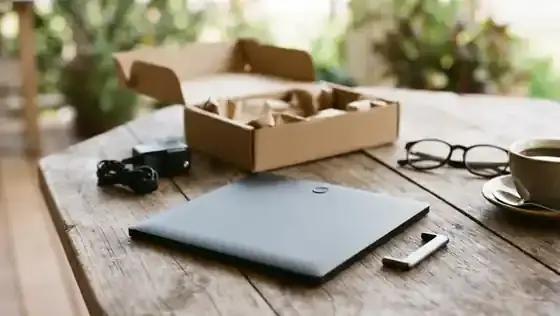
"Wi-Fi Compatibility: Works with iOS and Android." This one is about the family's phones, not mine.
Whoever sends the pictures needs the Frameo app, which the seller says costs nothing and works on both kinds of phone. The frame needs your home Wi-Fi to receive anything new.
The Questions at the Bottom of the Page
Every seller's page has a section at the bottom where the real answers live.
On this one it's called "Frequently Asked Questions," and I read every one of them, including two I didn't care about.
Asked whether there is a subscription fee, the page answers that "the Relish digital photo frame has no ongoing fees."
It adds that you receive unlimited cloud storage for photos and videos at no charge.
That was the answer that moved me from "no" to "maybe." I've had enough of devices that cost one price at the store and another price every month after.
Asked whether several people can send photos, the page says yes: "Invite friends and family through the Frameo app."
Once someone accepts, they can send pictures or short videos "straight to your frame wherever they are."
And the other side of that coin, which the page also prints: "only people you invite can send pictures to the digital photo frame, and everything is encrypted."
No strangers, no advertisements, no pictures from people you didn't ask.
Asked about captions, the page answers in one line: "Yes you can add captions to the pictures in the Frameo App." That's the answer I'd been looking for since Arlene's porch.
Asked about night, the page says "you can set a sleep schedule in the Frameo app or turn the frame off manually using the power button."
On a porch that matters, because a lit screen at midnight is a lantern for every moth in Washington County.
Without Wi-Fi, the page says, new photos can't arrive, but "previously downloaded photos will remain visible offline."
When our internet went out for a day in August, the frame kept showing everything it already had.
On photo shapes, the page advises "landscape photos with a 16:9 ratio," and says "portrait and square photos will appear with side borders."
I'll come back to that one, because it's the only advice on the page I had to translate for my family.
There was also one question I'd skip if I were you, because it confused me.
One answer on the page talks about using the frame "outside the UK" and on "UK mains (230 V)," which is clearly written for their British customers.
The American store ships from inside the country, and the adapter in our box fit our outlet. If you want to be sure before you order, the U.S.
line will tell you which plug comes in your box.
Five Steps, and None of Them Were Mine
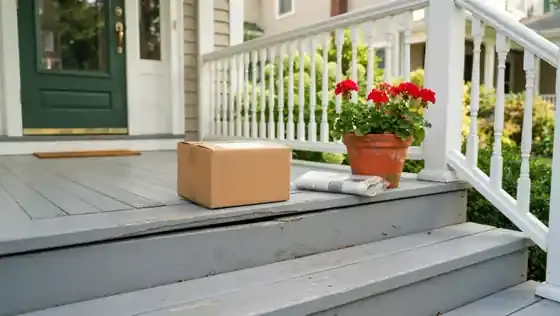
Allison ordered it on a Thursday night in May.
The page lists three ways to ship it, all from inside the United States, and the one she chose cost nothing because the order was over $35.
The box came the following Wednesday, four working days later, on the porch steps by the loose board I'd bought those screws for.
I took that as a sign of something and left it for Allison.
Here are the setup steps exactly as the seller's page prints them. I'm copying them because they're shorter than anything I could write.
Step two is the only one that needs somebody in the house. Marian did it, with Allison on speakerphone, and I'm told I said "don't press anything you can't unpress" four times.
Steps three through five happened in Raleigh.
Allison opened the app on her phone, chose "This frame is a gift," and read a code off the frame that Marian held up to the camera.
From the time Marian plugged it in to the time the first picture appeared, the kitchen clock says nineteen minutes.
Eleven of those were spent finding the Wi-Fi password, which was on a card taped inside the cabinet over the stove, where I put it in 2016 and forgot.
If you're giving one as a gift, the page has a note about that too.
You can't load photos onto it before it's been plugged in and connected to Wi-Fi, so if you want it to arrive full of pictures, you set it up, add the photos, and then repack it.
The first photo that arrived was a picture of me.
It was me at Allison's wedding in 2008, the one wedding of the 1,140 I didn't photograph, in a rented gray suit, crying at the end of the aisle.
Under it, Allison had typed: "Dad, off duty, Saint John's, 3:14 p.m." I had to go inside for a minute.
Grandpa did you get my softball picture yet
6:40Not yet. Your mother sent me crying in a rented suit first.
6:44lol. ok sending now. I'm writing the caption myself
6:45Got it: "Shortstop, bad hair day, not my fault." Good cutline.
6:51what's a cutline
6:52Come to the porch at Thanksgiving and I'll show you.
6:53A Frame, Not a Telephone, Not a Clinic
Before I tell you how the summer went, I want to tell you what this thing isn't.
Advertisements for gadgets like this one tend to drift, and I've seen some of them drift a long way.
It is not a telephone. It doesn't make calls and it doesn't take them.
There's no video calling on this frame, and the seller doesn't say there is.
If you've seen frames that let a grandchild's face pop up and talk to you, that's a different product from a different company, with its own monthly fee.
It is not a tablet. There's no web browser, no email, no games, no news, no store to wander into.
For me that was a feature, not a missing piece. Marian's tablet has forty-one things on its home screen, and this frame has one job.
It is not a camera. Nothing on the seller's list says it has a lens or a microphone, and nobody can look into your living room through it.
I checked that line twice, as a man who has spent his life on the other side of lenses. The pictures go one way: from the family's phones onto the frame.
It is not a clock, a calendar or a reminder board. The same company sells other devices for that kind of thing, and they're separate products with separate prices.
If you want the date on the screen or a note about Tuesday's appointment, this isn't that.
This shows photographs and short videos, one after another, with a line of text underneath if somebody types one.
And it is not anything for your head. I want to say that plainly, because the frame's own sales page leans hard in a direction I won't follow.
The seller's page talks about "moments of recognition" and quotes a study about older people and photographs.
I'm not quoting any of it, and you shouldn't buy a picture frame because of it.
What happened to me at Hoffman's Hardware still happens. Last week I spent a full minute looking for the word "colander" while Marian stood there holding one.
The frame didn't change that, and it was never going to.
What it changed is what's sitting on the table next to my chair, and who's in it, and what year it is in the pictures.
Teaching a Family to Write Under a Photograph
For the first three weeks, the photos came with no captions at all.
Allison sent forty-two pictures in the first two days, then almost nothing for the next four, which I'll come back to.
A photo without a caption is a stranger, the old newspaperman said.
And I found out he was right in a way I hadn't expected: I'd look at a picture of a birthday party and spend the whole slide trying to work out whose.
So I did something I hadn't done in fourteen years. I picked up the telephone and gave my family a lesson in cutlines.
A good cutline answers three questions: who, where, and what's happening that the picture can't tell you on its own.
It's one line, and it's written for a stranger who'll see it in twenty years.
"Sam, Pullen Park pool, first time off the high board" is a cutline, and "Fun day" is not, and I said so to my son-in-law, Dev, as kindly as a man can say anything to his son-in-law.
Allison started captioning everything within a week. Dev took longer, and his captions are mostly about the food, which tells you a lot about Dev.
Lily, at eleven, turned out to be the best writer in the family.
"Grandma's tomato pie, attempt two, smoke alarm stayed quiet" is a line I'd have been proud to write in 1985.
The second lesson was about shape. Remember that line on the seller's page about 16:9 photos?
It means sideways pictures fill the whole screen, and tall pictures get gray bars down both sides.
Everybody in my family holds their phone straight up and down, the way you'd hold a sandwich.
So I told them: turn the phone on its side for the frame.
That one sentence made more difference to what I see on my porch than anything else, and it cost nothing.
I really did mail that card, on actual card stock, to three addresses.
My brother Walt in Tucson taped his to his refrigerator and sent me a photo of it as the first picture he ever sent to the frame.
The caption was "Card received, Tucson, refrigerator, 7:02 a.m." Walt is seventy-four and he has never followed an instruction of mine in his life, so I'm counting that as a family record.
What It Costs, at the Door and After
Let's talk about money, because this is the section every gadget column rushes through. I'm going to go slowly.
The frame is $119.99. That's the only price on the U.S. page, there's one model, and there was no crossed-out "regular" price next to it when I read it in October.
Shipping depends on the option you choose. The page lists USPS Standard at $3.99, which becomes no charge on orders over $35, so for this frame alone it's nothing;
UPS Standard at $7.99; and USPS Express at $9.99.
And then, after the door, the page's answer is zero.
No monthly fee, no subscription, no "premium" tier for the captions or the sleep schedule; it's all on the page as one purchase.
For a man who spent his career paying for film, paper and chemistry by the month, that's a novelty.
I've had the frame on my porch for five months now, and I haven't paid it another cent.
The one cost the page doesn't mention is the one you already have: Wi-Fi.
If your house doesn't have it, this frame will show whatever photos were loaded the day it was last connected and nothing new after that.
So here's the honest arithmetic: $119.99, delivery from nothing to $9.99, plus the Wi-Fi you're already paying for or the Wi-Fi you'd have to get.
If you'd have to get Wi-Fi only for this, I'd think hard first.
For comparison, the last album I made in 2009 cost me $86 in materials at my own wholesale price, and it has been opened twice.
The frame on my porch has shown me, by Allison's rough count, a little over 2,300 pictures.
What the Neighbors Said
I should tell you now that the seller's page doesn't show customer reviews for this frame that I could quote.
There's a star rating on the product card and a review widget for the whole store, but no written reviews of this model that I could put my name next to, so I'm quoting none.
What I can tell you is what happened on my porch.
Our street is the kind of street where people stop at the bottom of the steps and talk, and that summer they started coming up the steps.
Gene Hollis was the first.
He came over in June to borrow a hedge trimmer and stayed for forty minutes, because a picture of Lily at a softball game came up and he wanted to know what position she played.
Shortstop, I told him, because the caption had said so three days earlier. That's not a claim about my head;
it's a claim about the table, where the answer had been sitting since Tuesday.
Gene's wife, Pat, came over the next week with a pie and an agenda.
Their grandchildren are in Denver and she wanted to know what it cost and whether Gene could work it.
"Gene doesn't have to work it," I said. "Your daughter works it from Denver."
The mail carrier, a young woman named Destiny who has been on our route for six years, stops for a ten-second look most days now.
She says she's following Sam's swimming "like a soap opera."
Reverend Okoye from Saint Mark's sat with Arlene and me one evening in August.
He watched about twenty pictures go by, four households' worth, and called it the best church bulletin he'd ever read.
None of these people are reviews, and I'm not presenting them that way.
They're neighbors on a porch, and what they did, over and over, was ask about the people in the pictures.
That's the part I hadn't counted on.
The frame didn't just bring the pictures to me, it brought the conversation up the steps, because a picture on a table is something a visitor can see and a picture in a phone is not.
Ned, what was the name of that company again? Gene says "the frame people."
10:15Relish, and the app the family needs is Frameo. Have your daughter set it up from Denver.
10:22And there's really no monthly bill?
10:23Not on their page, and not on mine. Read the return rules before you order, like I did.
10:25You sound like the bank.
10:26The bank never brought me pie.
10:26Four Days of Nothing, and Why I Almost Unplugged It
I promised I'd come back to the four days. Every honest column about a gadget needs a week where the gadget looked like a mistake, and this was mine.
Allison sent forty-two pictures in the first two days, the way people do when something is new.
Then she went back to work, Dev went on a business trip and nobody sent anything from Sunday to Thursday.
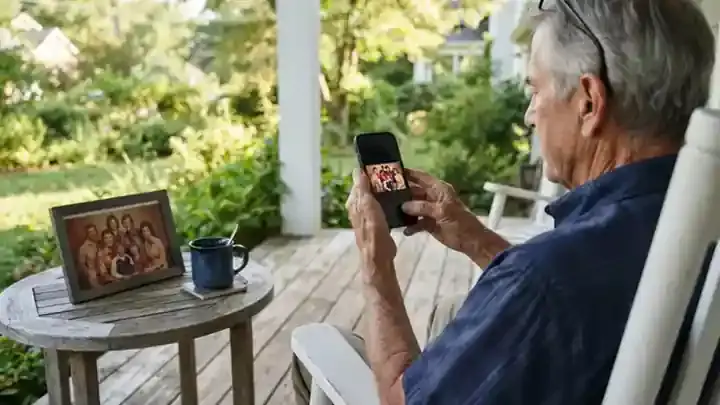
The frame kept cycling through the same forty-two, which is what it's supposed to do.
By Wednesday I knew every one of them by heart, including a blurry photo of a parking garage that Dev had sent by accident.
On Wednesday night I said to Marian, "Well, that's that," and I meant it. I had my hand on the cord.
Marian, who has been married to me for forty-seven years, said, "Ned, it's a newspaper. Newspapers have slow weeks."
She was right, and the next morning Lily got home from a field trip to the aquarium in Baltimore.
Thirty-one pictures arrived before lunch, each with a cutline, most of them about a sea turtle named Calypso.
I tell you this because I'd want to know it.
The frame is only as good as the people sending to it, and the people sending to it have jobs, children and slow weeks.
If you're the one who'd be receiving, it helps to have more than one sender. By August we had six:
Allison, Dev, Lily, my son Peter in Columbus, his wife Grace and my brother Walt.
If you're the one who'd be sending, here's my request on behalf of every grandparent in America.
Two pictures a week with one line each beats forty pictures once and silence after.
The One I Don't Have to Go Find Anymore
In July, Allison and the kids drove up from Raleigh for the Fourth.
On the second evening, while I was grilling, Allison went into the hall closet, moved the vacuum and the two winter coats, and took out the first album.
She didn't ask me. She sat at the kitchen table with her phone and photographed every page of our 1979 wedding album, sideways, the way I'd taught her.
Then she did the next one, and the next, and Lily took over for her at album four. By the time they drove home on the sixth, they'd photographed nine albums.

Those pages come up on the frame now, mixed in with the new ones.
A picture of Sam off the high board, then my mother at her sister's wedding in 1951, then Lily's tomato pie.
And under the old ones, Allison typed the captions I'd written in grease pencil forty years ago. "Ned & Marian, Saint John's steps, June 1979, 2:40 p.m., it rained at 2:45."
I put the first album on the side table next to the frame after that. It stays closed most days, and the cat sleeps on it.
I don't have to go find it anymore. It's not that I open it more often;
it's that the pictures in it come by on their own, at the size of a hardcover book, between a pool and a pie.
A Screen That Goes Dark When the Porch Does
I said I'd come back to the sleep schedule. It deserves its own section, because it's the feature I'd have asked about first if I'd known to.
A lit screen on a porch at night is a problem: it's a lantern for moths, it's a glow in the bedroom window, and it's one more thing in the house that never turns off.
Marian brought this up before the box was even open.
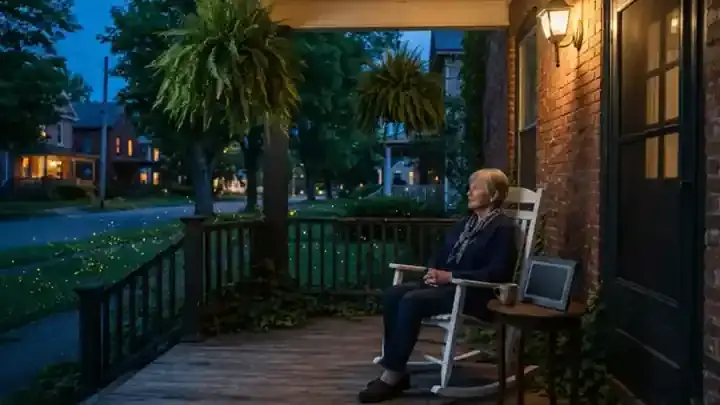
The seller's page says you can "set your own schedule for when the frame dims or turns off," using the app, or just press the power button.
It took us until July to get around to it, and then Allison set ours from Raleigh in about a minute.
Ours goes dark at nine-thirty and comes back at seven in the morning.
On a summer evening, when the porch light comes on and the frame goes dark, it feels like a shop closing up.
The page also says the images "transition at a smooth pace, with no flashes or sudden movement."
That matches what I've seen: one picture fades into the next, slowly, nothing blinks and nothing scrolls.
As a photographer I appreciated that more than I expected. A picture deserves a few seconds to itself before the next one shoves it out of the way.
Twenty Weeks on the Side Table
I kept a log, on the backs of old 4×6 prints, the way I used to keep a shot list. Here it is, condensed, without the parts about the weather.
Ned's porch log, May to October
- Week 1Plugged in on a Wednesday. Nineteen minutes to the first picture, eleven of them hunting the Wi-Fi password. Forty-two photos in two days, no captions.
- Week 2Nothing from Sunday to Thursday. Hand on the cord Wednesday night. Lily's aquarium trip on Thursday: thirty-one photos, every one captioned.
- Week 3The cutline phone call. Mailed the card to Raleigh, Columbus and Tucson. Walt's first photo: his refrigerator.
- Week 5Gene Hollis stayed forty minutes for a hedge trimmer. Pat came with a pie and questions. Turned the frame sideways on its second stand.
- Week 7The Fourth of July. Allison and Lily photographed nine albums at the kitchen table. The vacuum moved to the garage.
- Week 9Sleep schedule set from Raleigh: dark at 9:30, back at 7:00. Old wedding pages mixed in with new pool pictures. First album moved to the side table.
- Week 12Internet out for a day in August. The frame kept showing everything it had. Nobody on the porch noticed but me.
- Week 16Peter and Grace in Columbus started sending. Rosie, eleven months, first steps, captioned "toward the dog, not toward us."
- Week 20Lily's science fair, third place. "Tell Grandpa the light was terrible." It was.
I want to slow down on week two again, because I think it's the week most people would give up.
The frame showed the same pictures for four days because nobody sent new ones, and that's not a defect, that's a family.
And week twelve is worth a word. The internet went out on a Tuesday afternoon, and I only knew because Marian's tablet stopped working;
the frame just kept cycling through what it already had, exactly as the page said it would.
Week five, the stand: the frame comes with two magnetic stands, one for each direction.
I moved it from upright to sideways and the photos turned themselves, which is a small thing that made Gene say "huh" out loud.
Week sixteen is my favorite, and it's not my story, it's Peter's.
Rosie took her first steps toward the dog, and Grace got it on video, and it played on my porch table at four in the afternoon while I was shelling peas.
Sent you something. Turn the sound up on the frame.
3:58Watched it four times. She's going to be fast.
4:06Grace wants to know if the caption was all right.
4:07"Toward the dog, not toward us." Tell Grace she's hired.
4:09The Photographer Starts Sending Too
Here's the part of the story I didn't see coming. Sometime in August, Arlene asked me to send pictures to her frame.
The app lets the person who owns a frame invite other people to send to it.
Darnell, in Phoenix, sent me an invitation to his mother's frame, and Allison put the Frameo app on my phone and showed me the one button I'd need.
I hadn't taken a picture on purpose since I closed the studio in 2018.
I'd sold the cameras, all but one, and that one sat on a shelf in the den like a retired dog.
But now there was a frame two houses down, on the table of a woman whose family lives two thousand miles away. And what Arlene wanted was the street:
her ferns, her steps, the church on a Sunday, the Hollises' dog.
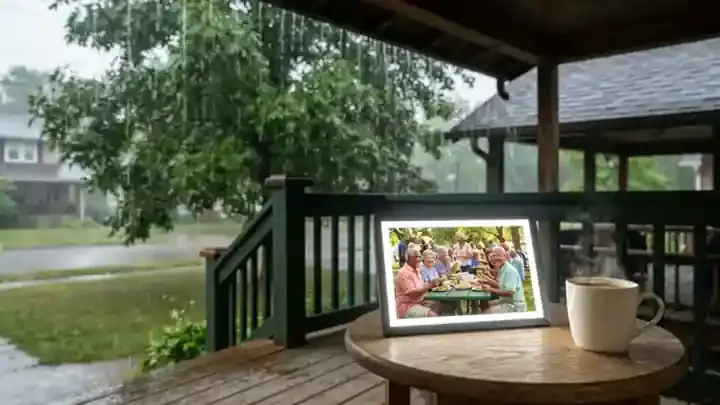
So I started taking pictures again, with my phone, held sideways. I send Arlene one a day, usually around noon, with a cutline.
"Your ferns, 11:40 a.m., the big one has opinions about the wind." Or: "Saint Mark's, Sunday, Reverend Okoye mid-sentence, as usual."
The rainy-day ones are her favorites. Rain off a porch roof is about the hardest thing there is to photograph well, and I've been trying to do it right since 1978.
Arlene says my pictures arrive "like the mail, only on time."
I've taken more photographs in the last three months than in the five years before it, and every one of them has a caption.
I'm not telling you that to sell you anything.
I'm telling you because the frame on my porch turned out to have a second door, one that opens the other way, and the man who walked through it was me.
My brother Walt, in Tucson, doesn't have a frame. He refuses on principle, he says, though he has never once told me what the principle is.
But he sends to mine every Sunday, a sunset over the saguaros behind his house, with the same caption every week: "Still here, Tucson, 6:12 p.m."
The time changes with the season; the rest of the line never does, and I've come to wait for it.

Walt and I talk on the phone maybe once a month, the way brothers our age do, mostly about baseball. The sunsets come every week.
That's the frame at its best, I think. Not a gadget you operate, but a place where your family leaves you a note.
The Sender and the Receiver Are Two Different People
I've had a lot of men my age ask me about this frame since June, at church, at the barbershop and once in the checkout line at Martin's.
Almost all of them ask the wrong question first.
They ask, "Is it hard to use?"
The answer for the person on the porch is that there's nothing to use; the real question is whether somebody in the family will send to it.
So before you think about buying one, think about two people. The receiver is the one with the side table; the sender is the one with the phone and the pictures.
The receiver needs: a spot near an outlet, Wi-Fi in the house and somebody to do the nineteen minutes of setup.
That's all, and the somebody can be on the telephone from another state, as Allison was.
The sender needs: a smartphone, the Frameo app, an invitation to the frame and the habit of sending. The first three take five minutes, and the fourth is the whole ballgame.
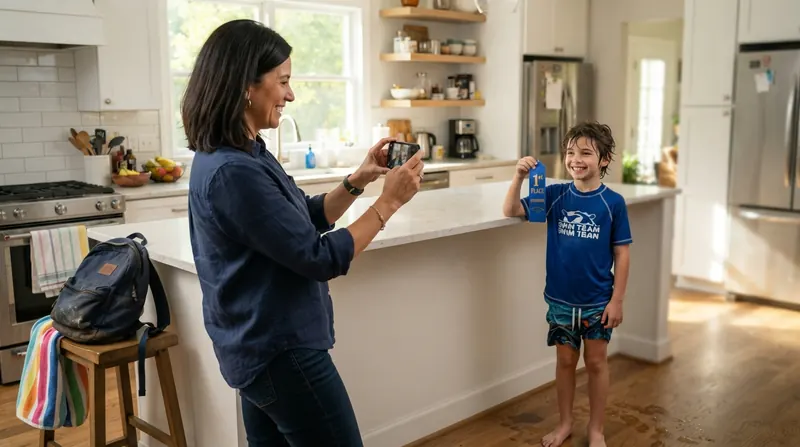
If your family is the kind that sends pictures to a group chat every week, this frame just gives those pictures a second home at a size you can see.
If your family is the kind that sends pictures twice a year, the frame will show those same pictures for a long time.
I'd also say this to the senders, gently.
Ask the person on the porch before you buy it, the way Allison asked me for four years.
A frame you didn't want is a frame you'll unplug, and you'll unplug it on a Wednesday in week two.
A frame you agreed to is a frame you'll give a slow week.
And one more thing for the sender, from a man who spent forty years choosing pictures. Send the ordinary ones.
The birthday parties and the graduations will come anyway. What I didn't know I'd been missing was a Tuesday: Sam's wet hair, Lily's science poster, Rosie's sock on the dog's head.
Those letters came in after the first version of this column ran in the church newsletter.
They're printed here as illustrative composites, with names and towns changed, and I'm showing them because they say the thing better than I can.
Ray's letter is the one I think about. A frame that does more is not a better frame if the person on the porch doesn't want the "more."
Two Neighbors, One Side Table, a Recorder Between Them
In September the church newsletter asked Arlene and me to record a conversation for their audio edition.
They set a little recorder on my porch table, between the frame and the album, and left us alone.
Saint Mark's Porch Tapes · Episode 7
Two Neighbors, Two Frames and One Very Good Cutline
Ned
host
Arlene, the newsletter wants to know why a church secretary convinced a wedding photographer to put a screen on his porch.
 Arlene
guest
I didn't convince you of anything, Ned; you sat on my porch for an hour and a half and watched a lizard. You convinced yourself, and your daughter had been waiting four years for you to do it.
Ned
host
Fair. What did you think, when Darnell first put yours on your table?
Arlene
guest
I thought it was a television, and I don't keep a television on the porch. Then the first picture came with a line underneath, Josiah in the bathtub with a beard of bubbles, and I laughed so loud the Hollises' dog barked; I've stopped calling it a television.
Ned
host
I want to say something on the record. Neither of these frames did anything for anybody's head, and we're not going to pretend they did.
Arlene
guest
Amen, I still lose my glasses on my own head twice a week. What changed is who comes up my steps, and what we talk about when they do; Reverend Okoye stayed an hour on Thursday because of a picture of Darnell's church choir in Phoenix.
Ned
host
Last question. What would you tell somebody who's thinking about one?
Arlene
guest
Ask your family first if they'll send, then read the returns before you order, the way you'd read a church contract. And tell them to turn the phone sideways, because Ned won't stop saying it.
The mail carrier came up the steps during the last answer, by the way, and you can hear her on the tape saying "is that Sam?" They left that part in.
I'm putting the numbers right here, before the button, because that's where I'd want them.
No headline, no clock ticking, just the line items the way I'd write them on an order envelope at the studio.
One frame, one price · photos sent from the family's phones · read the return rules below
The Return Rules and the Warranty, Read Like a Contract
Now the part most gadget columns skip, and the part I'd have read first at the studio: what happens if you don't like it.
I read the return policy on the page and then the full terms of sale, which are long and written for two countries at once.
Here's the short version, in the seller's own words: "no-hassle returns within 30 days if you're not completely satisfied with your order."
You arrange the return through a "Returns Portal" linked from the page.
The terms of sale add the details that matter. You may return any product bought from their website within 30 days of delivery for a full refund, for any reason;
it has to come back in its original condition; and the seller covers the return postage.
The one thing that doesn't come back is the original delivery fee. If you chose UPS or Express, that $7.99 or $9.99 is gone;
if you chose USPS Standard over $35, there was nothing to lose.
Then the warranty. The page says all their electronic products "include a 2-year warranty," and the delivery panel repeats "2 Year Warranty, on electrical items."
Thirty days is enough time to find out the thing that matters, which is whether your family will send.
If week two is quiet, don't panic, but if week four is quiet too, you'll have your answer while you can still send it back.
I'll add one thing a contract can't tell you. Keep the box.
The frame comes in a box that, according to the seller's page, says nothing about age on the outside, which I appreciated when it sat on my steps.
If you're going to return it, the box is the easiest way to get it back in "original condition."
Short answers to the questions I get on the porch
Does it make video calls?
No, this frame shows photos and short videos sent from the family's phones, with a caption line if the sender types one. There is no video calling on the seller's page, and I wouldn't want you to buy it thinking otherwise.
Is there a monthly fee?
The seller's page says no: "The Relish digital photo frame has no ongoing fees," with cloud storage for photos and videos at no charge. You do need Wi-Fi in the house for new pictures to arrive.
Who can send pictures to it?
Only people who've been invited through the Frameo app, and once they accept, they can send from wherever they are. The page says everything is encrypted and nobody else can send to your frame.
Do I need a smartphone to use it?
The person with the frame doesn't. Somebody needs the Frameo app on a phone or tablet to set it up and to send photos, and that somebody can be a son or daughter in another state.
Can I put captions under the photos?
Yes. The sender adds a caption in the Frameo app, and it shows as a line of text under the photo on the frame.
Can it go dark at night?
Yes. You can set a sleep schedule in the app so it dims or turns off at the hours you choose, or press the power button.
What happens if the internet goes out?
The frame keeps showing the photos it already has. It won't receive new ones until the Wi-Fi is back.
Can I return it?
Within 30 days of delivery, for any reason, in its original condition, with return postage covered by the seller; the original delivery fee isn't refunded. There's a 2-year warranty on electrical items.
Who sells it?
Relish, the trading name of Active Healthcare Solutions Ltd, registered in England and Wales, 72 Leonard Street, London EC2A 4QX. Orders ship from inside the U.S.; the U.S. customer line is 540-405-8541 and the email is info@relish-life.com.
It's probably a good fit if:
- Somebody in your family already sends pictures to a group chat, and you'd like to see them at the size of a book
- You'd rather have one thing with one job than a tablet full of buttons
- You have Wi-Fi at home, an outlet near your chair and a helper for nineteen minutes
- You want a line of words under each photo, written by the people who took it
- You'd like the old albums to come by on their own, between the new pictures
It probably isn't for you if:
- You want video calls; this frame doesn't make them
- Nobody in your family will send pictures more than a few times a year
- You don't have Wi-Fi at home and don't intend to get it
- You're hoping a picture frame will do something for your head; it won't, and nobody honest will say otherwise
- You'd rather keep the photos in albums and open them by hand, which is a fine way to live
That fourth line on the second list matters most to me.
This is a picture frame, a very good one, and the plan for everything else is whatever you and your own clinician write down together.
If You're Sitting on Your Own Porch With an Empty Side Table
I can't tell you what to do.
I can tell you what I'd do if I were reading this instead of writing it, back in April, with a closed closet full of albums and a name I couldn't find at Hoffman's.
First, I'd call whoever has the most pictures of my grandchildren and ask one question: "Would you send to a frame on my porch, twice a week, with one line each?"
If the answer is a laugh, I'd wait.
If the answer is "Dad, I've been asking you for four years," I'd read the page, the way I've done here.
Then I'd let them order it, set it up and send the first picture.
And I'd ask them to make the first picture one of me. It's a good way to start, as it turns out.
Relish Digital Photo Frame · one price, no monthly fee listed · 30-day returns
One more thing, and then I'll let you get back to your own porch. The frame is still on my side table, between the closed album and the cat.
Yesterday afternoon, at a quarter to five, a picture came in from Raleigh. It was Lily, holding her third-place ribbon next to a window, in good light for once.
Under it she'd typed: "Retaken in daylight, per Grandpa's instructions." I sat there through three more pictures before I went in for supper.
P.S. The thirty-one albums are still in the hall closet, but twenty-two of them come by my porch table on their own now, one page at a time, with the captions I wrote in grease pencil forty years ago, and if you have a closet like mine, the best thing you can give it is a phone held sideways at somebody's kitchen table.
P.P.S. Remember what Arlene wrote inside my box lid: the frame is for you, but the sending is for them, and Tuesdays count.
The full guide to the frame, the app and the advertising around it is linked at the foot of this page.
First, the people: Ned Calloway is a pen name. Marian, Allison, Lily, Sam, Arlene, Walt and the cat are composites, the way porch columns have always been written.
Everything about the frame itself comes from the seller's own pages, read in October 2026.
That means its price, its screen, its setup steps, its delivery options, its return policy and its warranty.